
Moving from an 80 m² to a 55 m² space is not just about removing a room from the plan. The relationship with objects changes, the way groceries are done evolves, and even the definition of the word “storage” transforms. Buying smaller forces a rethink of daily organization far beyond just sorting clothes or choosing a shelf.
Less living space, less stock at home
Have you noticed that in a large home, closets end up absorbing items that are forgotten for months? In a small space, this phenomenon disappears because every square meter counts.
Residents of compact homes shift from a domestic storage model (large fridge filled, entire packs of household products, full freezer) to a model of more frequent and targeted purchases. We buy what we need for a few days, not for three weeks. The giant pantry gives way to a small fast-rotation space, a shopping basket, or a well-organized mini-closet.
This change has a direct consequence on the type of storage needed. Large deep furniture becomes unnecessary. What works are narrow, accessible solutions where every item remains visible, as Immobilier du Net’s advice details for adapting one’s lifestyle to a reduced space.
In short, we store fewer things, but we store them better. The need is no longer about storage volume but about ease of access.
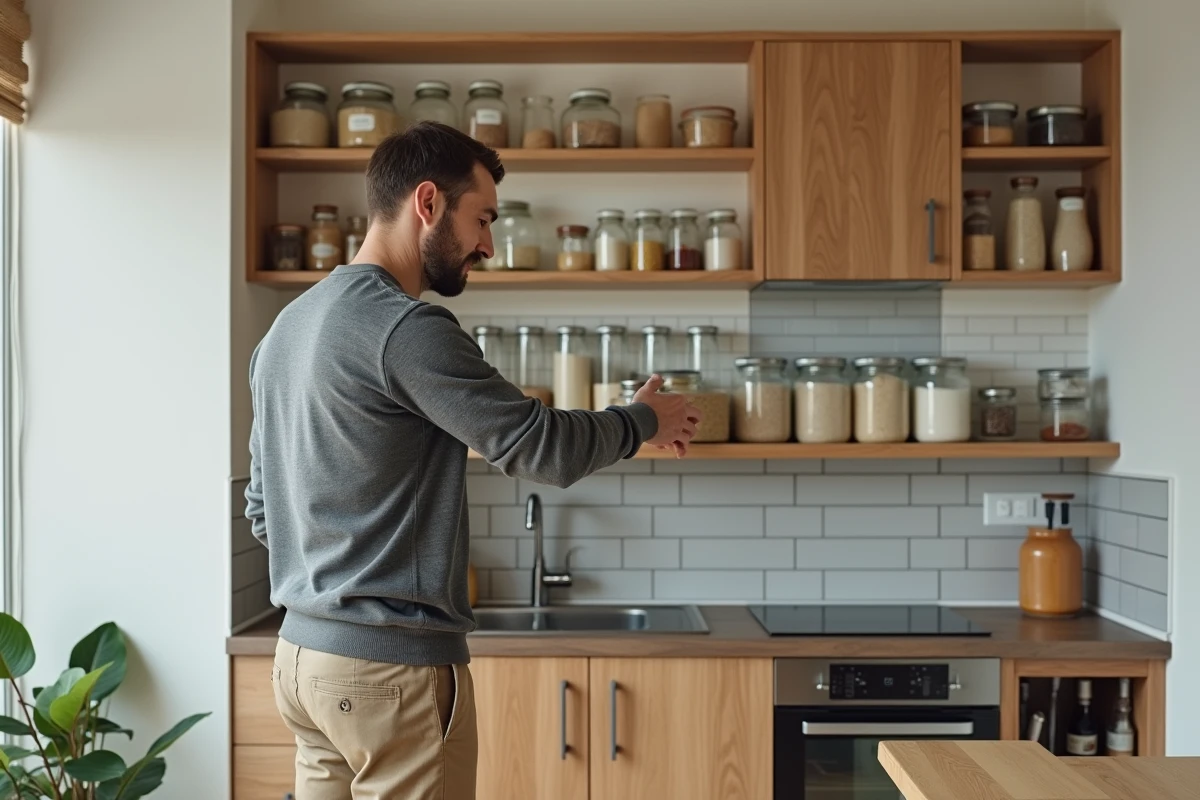
Kitchen and bedroom organization in a small home
The kitchen presents the biggest challenge. In a large apartment, appliances (food processor, toaster, blender, sandwich maker) are stacked. In a small one, every item placed on the countertop takes away from the usable cooking space.
The rule becomes simple: an appliance that is not used every week does not belong in the kitchen. Drawers replace high cabinets because you can see all their contents at once. Open shelves work well for everyday items (plates, glasses, spices), provided their number is limited.
- Group utensils by use (preparation, cooking, serving) rather than by category to enhance fluidity
- Favor stackable and transparent containers that fit the exact dimensions of the cabinets
- Reserve one drawer for “transit items” (mail, keys, chargers) to prevent them from taking over the entire room
The bedroom follows the same logic. In a small space, a storage bed or a storage box spring becomes a dual-function piece of furniture. Off-season clothes do not stay in the closet; they are vacuum-sealed or stored externally.
The trap of poorly thought-out multifunctional furniture
A piece of furniture that serves as a bed, desk, and storage seems ideal on paper. In practice, if each transformation takes several minutes, it ends up never being unfolded. A good multifunctional piece of furniture transforms in less than ten seconds, otherwise, it remains stuck in a single configuration.
Outsourcing storage: self-storage and object libraries
Buying smaller does not mean getting rid of everything. It means accepting that some items do not need to live at home permanently.
Self-storage has gained popularity in recent years, especially in densely populated urban areas. Seasonal items (ski gear, decorations, suitcases) are stored there, freeing up considerable space in the home. For occasional use, the cost is often lower than that of the additional square meter that would need to be rented.
At the same time, object libraries are developing in major European cities. The principle: borrow a drill, a steam cleaner, or a raclette machine instead of owning it. Fewer items stored at home means fewer storage furniture needed.
These practices change the way we organize our interiors. We move from storage designed to “keep everything at home” to a flow management: what we borrow, what we return, what we have delivered. The entry closet no longer serves to accumulate but to manage rotations.

Adapting storage for children in a small space
A small home with children poses a specific challenge: toys, books, and school supplies take up a disproportionate volume compared to their size.
The most effective solution is to apply the principle of rotation. Instead of leaving all toys accessible at all times, keep a limited selection and rotate them every few weeks. Children rediscover their toys as if they were new, and the room stays tidy.
- Install open bins at child height so they can put things away themselves, without help
- Limit visible books to about ten and rotate the rest from a box stored up high
- Use under-bed space or a storage bench as the main storage area for toys
- Associate each activity with a specific area (drawing at the table, reading on the rug) to contain the mess
A child finds it easier to tidy up when there are fewer objects and each item has a defined place. In a small space, this rule is not an ideal; it is a necessity.
The role of evolving furniture
A convertible bed that goes from 90 cm to 120 cm, a modular shelf that gains a level each year: these solutions prevent the need to buy new furniture at every growth stage. In a small home, replacing each piece of furniture poses a logistical problem. Choosing furniture that grows with the child avoids frequent replacements.
Reducing living space permanently transforms the relationship with objects. Storage ceases to be a volume problem and becomes a matter of circulation and ongoing sorting. Buying habits change, external storage solutions take over, and daily organization rests on a simple principle: keep only what is used regularly at home.