In France, the 2026 school year marks a turning point for the regulation of digital technology among minors. The ban on mobile phones now extends to high schools, the CNIL publishes specific recommendations on AI in education, and law n° 2023-566 of July 7, 2023, requires parental consent for the registration of under-15s on social media.
Supporting children in their daily discovery of digital technology is no longer a matter of optional pedagogical choice; it is a legal and family framework to be built together.
AI-generated content: a blind spot in digital education
Competitors extensively discuss screen time and social media. However, they skim over a central topic: children’s ability to identify content produced or altered by generative artificial intelligence.
The CNIL published recommendations on AI in education in June 2025, which were reported by the Journal du Net in September 2026. These recommendations introduce the concept of synthetic content literacy, which goes beyond simply verifying classic misinformation. A text, image, or video may appear visually credible while being entirely fabricated by a generative model.
In practical terms, supporting a child in this area means showing them the manufacturing clues: inconsistencies in hands in an image, repetitive phrasing in a text, absence of an identifiable source. Educational resources are available on clic-et-moi.fr to structure this approach within the family, without technical jargon.
The difficulty is real: adults themselves often struggle to distinguish authentic content from generated content. Support then becomes a shared learning experience rather than a top-down transmission.

Social media and under-15s: what the law requires from parents
Law n° 2023-566 of July 7, 2023, stipulates that a minor under the age of 15 cannot register on a social network without explicit parental consent. Platforms must inform the child and their parents about the risks associated with using the service and offer tools for controlling screen time.
A holder of parental authority can also request the suspension of an account already created by a child without their consent. This right of suspension remains little known and rarely exercised.
What the law does not address
The Constitutional Council censored the general ban on social media for those under 15 that was initially planned. The system therefore relies on age verification by the platforms, the effectiveness of which is debated. Feedback from the field varies on this point: some parents find that their children easily circumvent control mechanisms by declaring a fictitious age.
The legal framework sets a direction, but the parental filter remains the decisive link. This involves regular discussions about what the child sees and shares, rather than merely activating software parental controls.
Ban on phones in high school: a signal, not a solution
Since the 2026 school year, the ban on mobile phones in schools also applies to high school students. This measure extends the one already in place in middle and elementary schools. It aims to limit distractions in class and reduce exposure to social media during school hours.
However, this ban only covers the time spent on the school premises. Screen time outside of school represents the majority of daily exposure. A high school student who hands in their phone at the entrance retrieves it at the exit, often for intense use at the end of the day.
The school ban can, however, serve as a lever to open dialogue at home. It creates a collective reference point on which parents can rely to set their own rules without appearing to be isolated cases.

Building an age-appropriate family framework
Institutional recommendations converge on one principle: adapting digital usage to the child’s maturity rather than setting the same hourly quota for everyone. A 7-year-old using a tablet for an educational game and a 14-year-old navigating social media do not require the same support.
Some concrete guidelines for structuring this framework:
- Define screen-free time slots shared by the whole family (meals, bedtime), which avoids targeting only the child and reduces the perception of unfairness
- Install screens in common areas for younger children, making usage visible without establishing constant surveillance
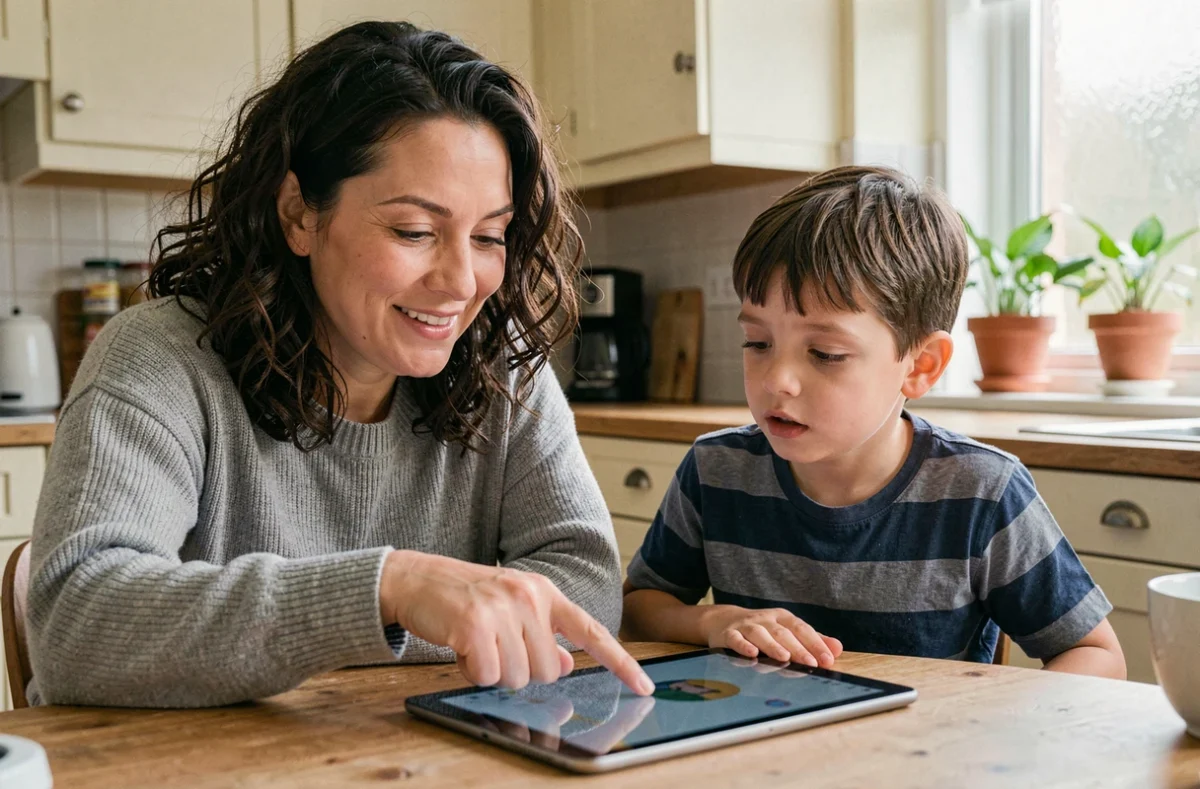
- Plan moments of accompanied use, where the parent watches or plays with the child, to understand what they are doing and open the conversation
- Regularly reassess the rules, as a fixed framework becomes obsolete in a few months in light of the evolution of platforms and usage
Personal data protection from primary school
The CNIL offers resources to raise awareness among CM2 students about data protection. This approach can be echoed at home by explaining to children what happens to the information they share: first name, photo, location, contacts.
A child who understands early that their data has value and a lifespan online adopts more lasting caution than a child simply subjected to restrictions.
The digital support of children relies less on technical tools than on an active parental stance. The French legal framework now provides concrete levers, from parental consent on social media to the ban on phones in schools. However, each family must translate these guidelines into daily habits, adjusted to the age and maturity of each child.